

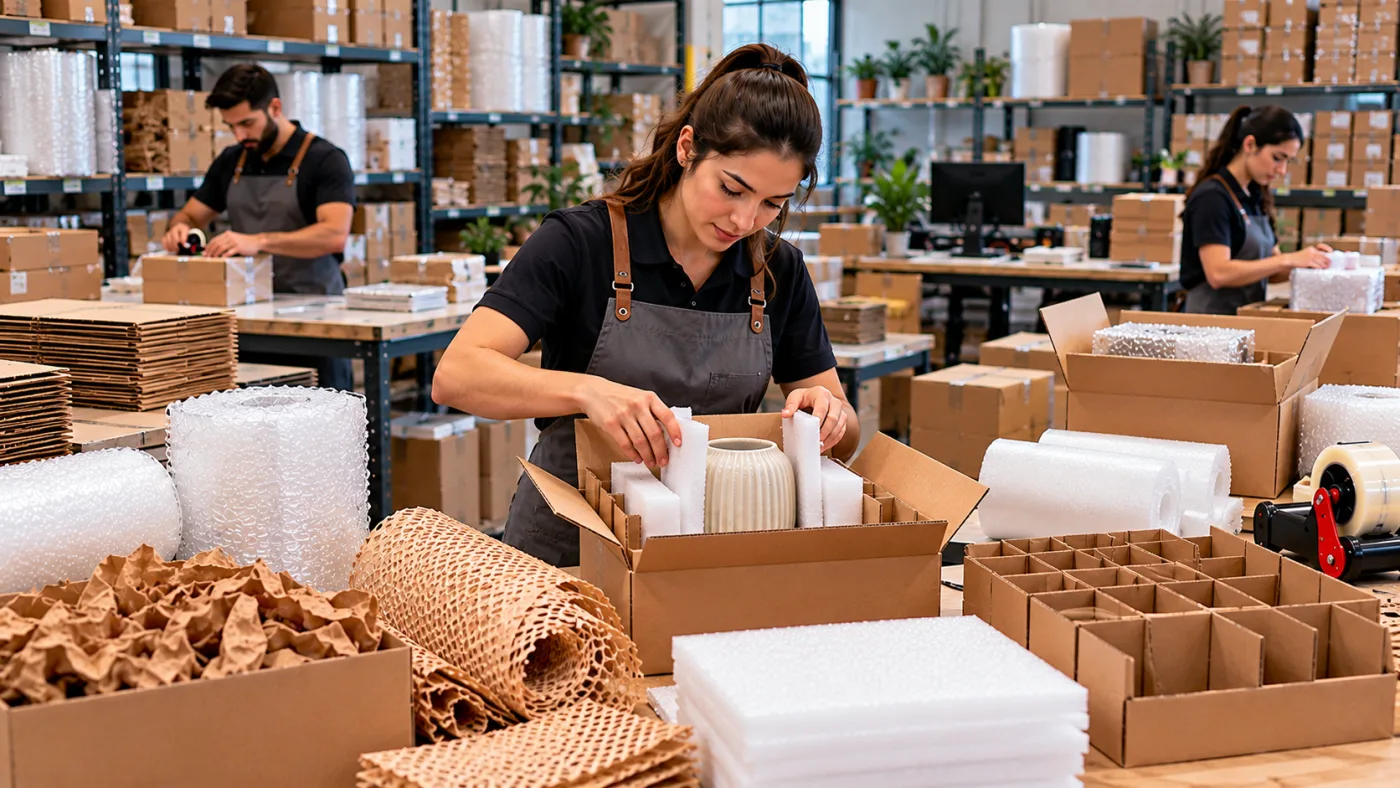
Protective packaging plays a critical role between the product and the outer shipping container.
For San Diego businesses preparing for 2027, selecting protective materials should begin with understanding how products can be damaged during packing, handling, transportation, and delivery.
Rather than adding the same cushioning to every shipment, businesses can build packaging systems around specific product risks.
What Does Protective Packaging Do?
Protective packaging can perform several different functions.
Depending on the product, it may help provide:
- Cushioning
- Void filling
- Product stabilization
- Surface protection
- Product separation
- Edge protection
A single shipment may require one or several of these functions.
Explore Cardo's Protective Packaging.
Start With the Product, Not the Material
Businesses should avoid selecting protective packaging simply because a material is familiar.
First evaluate the product.
Ask:
- Is it fragile?
- Is the surface easily scratched?
- Can it move inside the box?
- Does it have vulnerable corners?
- Are multiple items packed together?
- Is the product heavy relative to its size?
The answers help determine what type of protection may be appropriate.
Protective Packaging for Fragile Products
Fragile products can require protection against impact and movement.
The complete package should be considered:
Product → Protective Material → Corrugated Box → Closure
If one part of the system is unsuitable, adding more material elsewhere may not solve the problem.
Cushioning Materials for Shipping
Cushioning can help reduce the effect of impact on suitable products.
The amount and type required depend on factors such as:
- Product weight
- Fragility
- Shape
- Shipping environment
- Outer carton
- Expected handling
Businesses should test packaging configurations using actual products before standardizing them.
Void Fill and Cushioning Are Not Always the Same
These functions are related but should not automatically be treated as identical.
Void fill helps occupy unnecessary empty space and can reduce movement.
Cushioning is intended to help protect suitable products against impact.
A shipment may require one, both, or neither depending on the product and carton configuration.
Packing Paper for Commercial Shipping
Packing paper can be useful in appropriate packaging applications.
Depending on the shipment, it may help with:
- Wrapping
- Void filling
- Separation
- Light stabilization
The amount should be based on what the package requires rather than an arbitrary quantity.
Protective Packaging for Surface-Sensitive Products
Some products are more vulnerable to scratching or abrasion than impact.
Examples may include products with:
- Finished surfaces
- Coatings
- Decorative components
- Polished parts
- Sensitive exterior materials
These shipments may require suitable surface protection or separation.
Keep Products From Rubbing Together
Multi-item shipments can experience product-to-product contact.
Even if individual products are not highly fragile, repeated movement can damage surfaces.
Businesses can evaluate appropriate:
- Wrapping
- Dividers
- Separation
- Product positioning
The objective is to prevent unnecessary contact during transportation.
Dividers for Multi-Item Shipments
Dividers can be useful when several products share the same carton.
They may help:
- Separate items
- Maintain organization
- Reduce direct contact
- Create defined product positions
Divider selection should reflect product size, weight, shape, and shipment requirements.
Protect Vulnerable Edges and Corners
Some products or commercial loads have vulnerable edges.
Where appropriate, edge protection may help protect these areas or support selected load-containment configurations.
Businesses should evaluate edge protection as part of the complete package rather than as an isolated component.
Choose the Correct Outer Shipping Box
Protective material cannot fully compensate for an unsuitable outer carton.
Businesses should also consider:
- Carton dimensions
- Product weight
- Packed weight
- Required protective space
- Shipping environment
Explore Cardo's Corrugate solutions.
Avoid Oversized Boxes
An oversized shipping carton can create excessive empty space.
This may require additional void fill and allow more opportunity for product movement if the shipment is not stabilized correctly.
Right-sizing can help create a more controlled packaging configuration.
Don't Choose a Box That Is Too Tight
Reducing empty space does not mean forcing products into the smallest possible carton.
Fragile products may require space for appropriate cushioning or separation.
The correct carton should provide enough room for the complete protective system.
Protective Packaging for San Diego E-Commerce Businesses
E-commerce businesses may ship many individual products through parcel networks.
High-volume products can benefit from predefined packaging configurations.
For example:
Product A → Box A → Cushioning A → Tape → Label
This creates a repeatable process for packing teams.
Standardize Fragile-Product Packaging
When the same fragile product ships frequently, document the packing method.
Instructions can define:
- Carton
- Product orientation
- Protective material
- Quantity of material where appropriate
- Closure procedure
This can reduce variation between employees.
Protective Packaging for Manufacturers
Manufacturers may ship components, parts, equipment, or finished goods.
Potential risks can include:
- Surface damage
- Product movement
- Contact between components
- Vulnerable edges
- Impact during handling
Packaging should reflect the physical characteristics of the product.
Protective Packaging for B2B Shipments
Commercial orders may contain multiple units or multiple cartons.
Businesses should consider protection at both levels:
Inside the carton: protect individual products.
Across the shipment: protect cartons and maintain an appropriate overall load configuration.
This becomes particularly important when cartons are palletized.
Seal Protected Products Correctly
Once products are positioned and protected, the carton needs appropriate closure.
Explore Cardo's Tapes & Adhesives.
A well-protected product can still be exposed if the outer carton does not remain properly closed.
Don't Overfill the Carton
Excessive protective material can create problems if it prevents the box from closing correctly.
Signs of overfilling can include:
- Bulging sides
- Raised flaps
- Excessive pressure
- Difficulty applying closure
The packaging configuration should be adjusted rather than forcing the carton shut.
Test Product Movement Before Shipping
Before sealing a test package, businesses can evaluate whether the product is appropriately stabilized.
The exact method depends on the product, but the objective is to identify unwanted movement before the shipment enters transportation.
Testing should be performed safely and appropriately for the item.
Track Shipping Damage by Type
Businesses can learn more by categorizing damage.
For example:
Breakage: investigate impact protection and product movement.
Scratching: investigate wrapping and separation.
Bent corners: investigate edge protection and carton configuration.
Crushed outer box: investigate carton selection and stacking.
Product movement: investigate stabilization and void space.
This helps identify the likely cause.
Avoid Solving Every Problem With More Material
If a product is repeatedly damaged, simply adding more cushioning may increase cost without correcting the underlying problem.
The issue may instead involve:
- Incorrect box size
- Poor product orientation
- Inadequate separation
- Incorrect carton selection
- Excessive movement
Businesses should identify the failure before changing the package.
Measure Protective-Material Consumption
High-volume operations can track how much protective material is used.
Monitor consumption by:
- Product
- Order type
- Packing station
- Shipment volume
Large unexplained differences can indicate inconsistent packing procedures.
Reduce Unnecessary Protective Packaging
Material efficiency should not compromise required protection.
Instead, businesses can investigate:
- Excessive void fill
- Oversized cartons
- Duplicate protective layers
- Unnecessary wrapping
- Repacking
The goal is to use enough appropriate material to perform the required function.
Consider Packing Time
Complex packaging can increase labor.
Businesses can monitor how long employees spend:
- Wrapping products
- Adding cushioning
- Creating dividers
- Filling empty space
- Repacking orders
If a high-volume product takes too long to prepare, the packaging configuration may need review.
Create Protective-Packaging Stations
Businesses shipping many fragile products can organize packing stations around common materials.
Frequently used supplies should be:
- Accessible
- Clearly organized
- Protected from damage
- Replenished consistently
This can reduce time spent searching for materials.
Prepare Protective Supplies for Demand Peaks
Before promotions, seasonal periods, or large commercial orders, review inventory of:
- Protective materials
- Corrugated cartons
- Tape
- Dividers
- Specialty packaging
A shortage of one component can interrupt the entire packing process.
Protective Packaging for Palletized Orders
Larger commercial shipments may combine multiple cartons onto a pallet.
Before palletizing, businesses should ensure individual cartons are properly packed and closed.
Once the pallet itself is stable, stretch film can help provide load containment.
Explore Cardo's Stretch Wrap Film.
Additional Load Protection
Certain commercial loads may require additional containment according to weight, shape, height, handling, or transportation requirements.
Explore Cardo's Strapping & Load Containment.
Protection should be evaluated across both the individual product and the complete shipment.
Calculate the Cost of Product Damage
Protective packaging decisions should not be based only on material cost.
Product damage can involve:
- Replacement product
- Additional shipping
- Customer service
- Repacking
- Processing time
- Lost inventory
This is why the cheapest protective material is not automatically the lowest-cost solution.
Test Packaging Before Large-Scale Use
Before standardizing a new protective configuration, businesses can test:
- Product fit
- Movement
- Cushioning
- Separation
- Carton closure
- Handling
- Packing time
Testing is especially valuable for frequently shipped or higher-value products.
Build a Protective Packaging System for 2027
A practical approach can follow:
Identify Product Risk → Select Outer Carton → Add Required Protection → Stabilize Product → Close Carton → Test → Monitor Damage
This keeps protective packaging connected to a defined purpose.
Choosing Protective Packaging in San Diego for 2027
Businesses searching for protective packaging in San Diego for 2027 should begin with the product and the shipping risks it is likely to encounter.
Fragile items may require appropriate cushioning. Multi-item shipments may require separation. Surface-sensitive products may need wrapping, while empty space may require suitable stabilization or void fill.
The strongest packaging configuration is one in which the protective materials, corrugated carton, and closure work together.
Cardo provides protective packaging, corrugated solutions, tapes and adhesives, stretch film, strapping, and other commercial shipping supplies for e-commerce businesses, warehouses, manufacturers, distributors, wholesalers, and other businesses serving San Diego and broader U.S. and Canadian markets.