

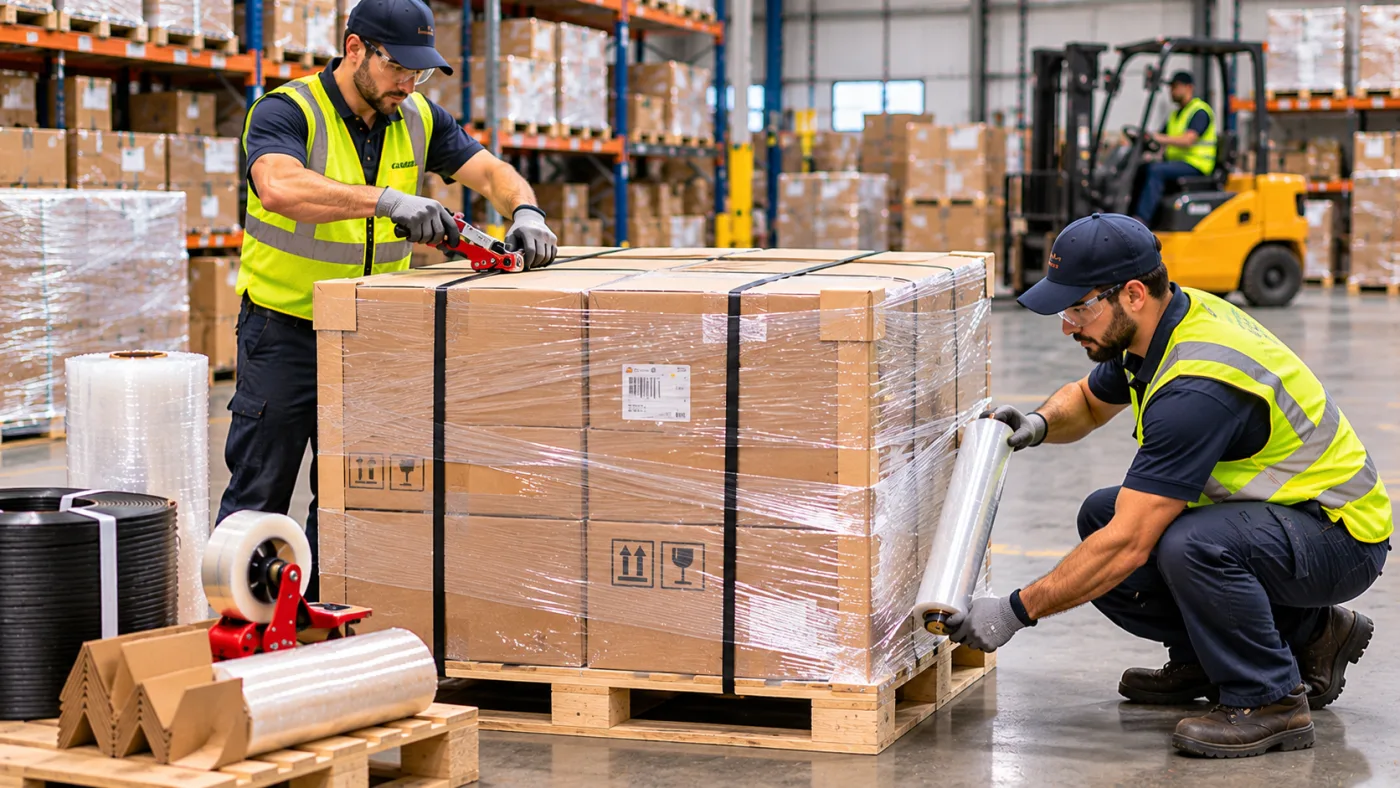
Palletized shipping is an essential part of warehouse, manufacturing, distribution, and fulfillment operations across the USA and Canada. But placing cartons on a pallet is only the first step. Loads also need to remain stable as they move through warehouses, loading docks, trucks, and distribution networks.
A well-planned pallet packaging process can help reduce load movement, protect products, and improve handling throughout the supply chain.
Why Pallet Packaging Matters
Pallet loads can experience movement at several stages of transportation.
Forklift handling, warehouse transfers, truck movement, stacking, and loading or unloading can all place stress on a shipment.
Effective pallet packaging helps keep individual cartons or products together as a single, manageable load.
Businesses should consider:
- Product weight
- Pallet dimensions
- Load height
- Carton arrangement
- Product fragility
- Transportation distance
- Warehouse handling
- Storage conditions
These factors can determine which load-containment materials are appropriate.
Start With a Stable Pallet Load
Secure pallet packaging begins before stretch film or strapping is applied.
Cartons should be arranged to create a stable base whenever product dimensions allow it. Uneven stacking, large gaps, or cartons extending beyond the pallet can make the load more difficult to secure.
Heavier cartons should generally provide a stable foundation, while lighter products should be positioned to minimize unnecessary movement.
The objective is to create a balanced load before applying containment materials.
Use Stretch Film to Improve Load Stability
Stretch film is one of the most common materials used for palletized shipments.
When applied correctly, stretch wrap helps hold cartons together and connect the load to the pallet.
Businesses can choose between hand and machine stretch film depending on their shipping volume and equipment.
Lower-volume operations may use hand-applied stretch wrap, while distribution centers and higher-volume facilities may benefit from machine wrapping.
Explore Cardo's Stretch Wrap Film solutions for pallet wrapping applications.
Consider Strapping for Additional Load Containment
Some pallet loads may require additional containment beyond stretch film.
Strapping can help secure heavy cartons, bundled products, or loads that need additional reinforcement during storage and transportation.
The appropriate strapping solution depends on factors such as load weight, product type, and handling conditions.
Cardo's Strapping & Load Containment range provides options for commercial pallet and shipping operations.
Protect Pallet Edges and Corners
Corners and edges can experience concentrated pressure when loads are wrapped or strapped.
Edge protection can help distribute this pressure and provide additional support to palletized cartons.
It can be particularly useful for tall loads, stacked cartons, or products where straps could otherwise place pressure directly against the packaging.
Combining edge protection with stretch film or strapping can create a more complete load-containment system.
Protect Products Inside the Cartons
A stable pallet does not automatically mean the individual products inside each carton are protected.
Products may still experience vibration, impact, or movement during long-distance transportation.
Cushioning, void fill, separators, and other protective materials can help reduce internal movement.
Businesses can explore Cardo's Protective Packaging solutions for additional product protection.
Prepare Pallets for Long-Distance Shipping
Businesses shipping between regions of the United States and Canada may need pallet loads to move through multiple warehouses, carriers, terminals, and distribution facilities.
Longer supply chains can mean additional handling.
Before dispatch, businesses should check:
- Pallet condition
- Carton stability
- Stretch-film coverage
- Strapping where required
- Edge and corner protection
- Shipping labels
- Load identification
- Overall pallet stability
A consistent pre-shipment inspection can help identify packaging issues before the pallet leaves the facility.
Avoid Excessive Stretch Film and Strapping
More packaging material does not always create a better load.
Excessive stretch film or unnecessary strapping can increase material costs and packing time.
Instead, businesses should match containment materials to the actual characteristics of each pallet.
High-volume warehouses can also review film usage, wrapping patterns, and packing procedures periodically to identify opportunities for greater efficiency.
Standardize Pallet Packaging Across Your Operation
Manufacturers, warehouses, fulfillment centers, and distributors handling repeat shipments can benefit from standardized pallet-packaging procedures.
A standard process may define:
- Pallet configuration
- Carton stacking pattern
- Stretch film specification
- Number of wraps
- Strapping requirements
- Edge protection requirements
- Labelling procedure
- Final load inspection
Standardization can improve consistency across packing teams and different warehouse shifts.
Pallet Packaging for USA and Canada Supply Chains
Businesses operating across the USA and Canada need packaging systems capable of supporting regional and long-distance distribution.
Whether products are moving between warehouses, fulfillment centers, retailers, manufacturers, or customers, the packaging system should be designed around the load and the journey it will experience.
Using appropriate stretch film, strapping, protective packaging, and load-containment materials can help create more stable palletized shipments.
Cardo supplies packaging solutions for businesses managing warehouse, distribution, manufacturing, and shipping operations across the United States and Canada.