

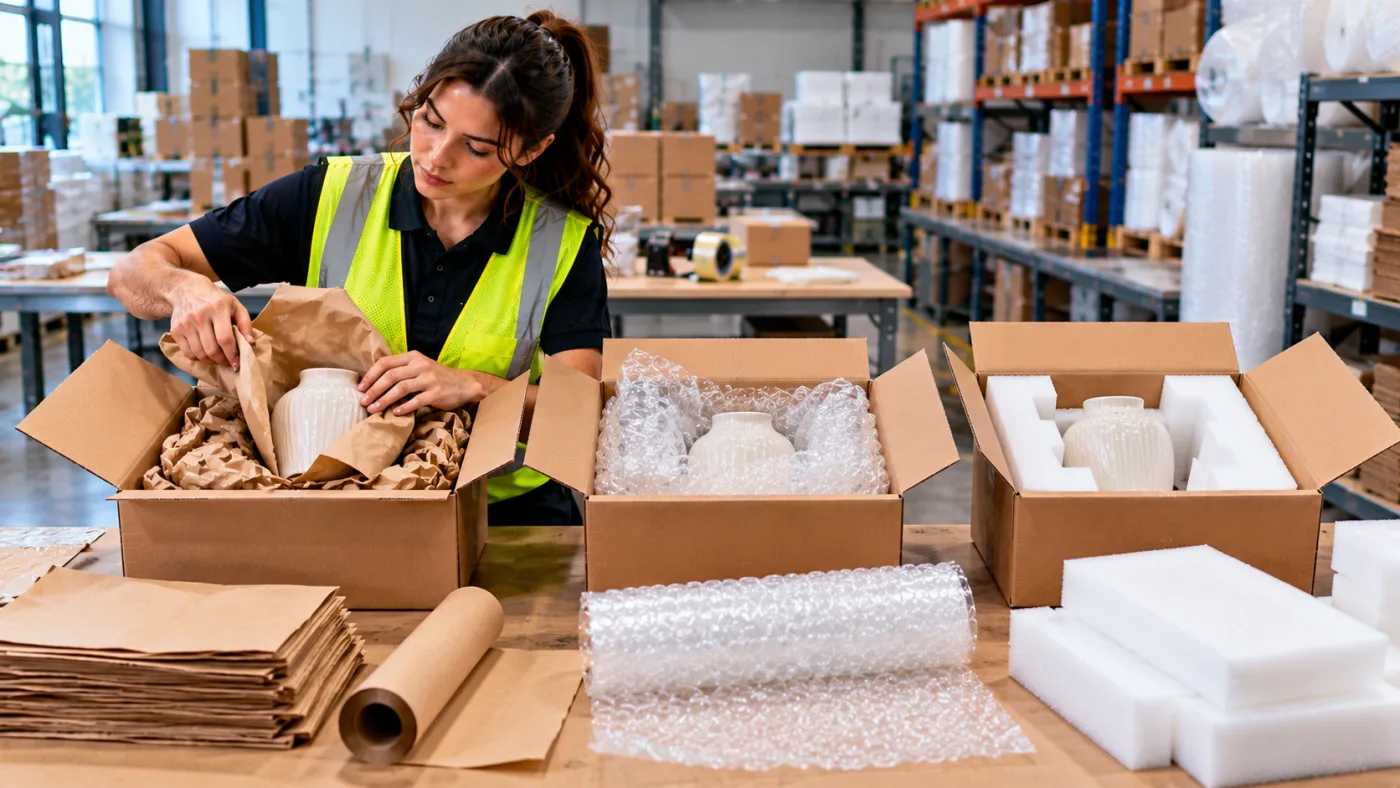
Protective packaging should be selected according to the product rather than using the same material for every shipment. A lightweight item that only needs stabilization inside a carton has different requirements from fragile glass, sensitive electronics, or a heavy component vulnerable to impact.
Packing paper, bubble cushioning, and foam can all be useful protective packaging materials, but each performs different functions. Understanding those differences can help businesses build a more consistent packing process while avoiding unnecessary material.
Why Protective Packaging Materials Matter
Products may experience movement, vibration, stacking, impact, and repeated handling as they travel through warehouses and transportation networks.
Protective packaging can help address risks such as:
- Product movement
- Impact
- Scratching
- Product-to-product contact
- Empty carton space
- Vulnerable edges
- Surface damage
Explore Cardo's Protective Packaging solutions for commercial shipments.
What Is Packing Paper?
Packing paper is a flexible material that can be wrapped around products or used to occupy empty space inside shipping cartons.
Businesses may use it for:
- Wrapping products
- Filling voids
- Separating items
- Stabilizing lightweight products
- Protecting certain surfaces
Its flexibility makes it useful for many everyday packing operations.
When Should You Use Packing Paper?
Packing paper may be appropriate when the primary goal is reducing movement or filling irregular empty spaces.
For example, a durable product placed inside a slightly larger carton may not require substantial cushioning but could still need stabilization.
Paper can be positioned around the product to reduce unnecessary movement.
Advantages of Packing Paper
Depending on the application, packing paper can provide several practical benefits.
It can be:
- Flexible
- Easy to position
- Useful for wrapping
- Useful for void fill
- Suitable for separating certain products
However, businesses should avoid assuming that paper alone provides sufficient cushioning for every fragile item.
What Is Bubble Cushioning?
Bubble cushioning uses sealed air pockets to create a protective layer around a product.
It is commonly used for:
- Fragile merchandise
- Glass products
- Electronics
- Accessories
- Components
- Sensitive products
The material can be wrapped around individual items before they are placed into a shipping box.
When Should You Use Bubble Cushioning?
Bubble material can be useful when a product requires more cushioning than simple void fill provides.
It may be appropriate for products vulnerable to:
- Impact
- Contact with carton walls
- Contact with other products
- Surface damage
The amount required depends on the product's weight, dimensions, fragility, and shipping environment.
Advantages of Bubble Cushioning
Bubble material can provide cushioning while conforming around different product shapes.
This can make it useful for individually wrapping fragile items.
However, adding large amounts of bubble material to an oversized box is not necessarily an efficient solution.
The carton should still be appropriately sized.
What Is Foam Packaging?
Foam packaging can be used in applications requiring cushioning, separation, surface protection, or additional support.
Different foam formats may be suitable for different products and packaging systems.
Businesses should evaluate foam based on:
- Product weight
- Product shape
- Fragility
- Surface sensitivity
- Required cushioning
- Shipping conditions
The appropriate solution depends on the application rather than the material name alone.
When Can Foam Be Useful?
Foam may be considered for products that require additional cushioning or surface separation.
Applications can include certain:
- Electronics
- Components
- Sensitive equipment
- Finished surfaces
- Fragile products
The product should be evaluated to determine whether foam provides a useful function within the complete package.
Packing Paper vs Bubble Wrap
The biggest difference is generally the type of protection required.
Packing paper may be useful for:
- Void fill
- Wrapping
- Separation
- Stabilizing lightweight items
Bubble cushioning may be useful for:
- Fragile products
- Impact cushioning
- Individual product wrapping
- Creating separation from carton walls
Some shipments may benefit from using both.
Bubble Wrap vs Foam
Bubble cushioning and foam can both provide protective functions, but the right choice depends on the product.
Consider:
- How fragile is the item?
- How heavy is it?
- Does it have sensitive surfaces?
- Does it have vulnerable edges?
- How much space is available inside the carton?
- Will several products share the box?
There is no single material that is universally better.
Packing Paper vs Foam
Packing paper can be useful when flexible wrapping or void filling is required.
Foam may be considered when a product needs a different type of cushioning or surface protection.
Businesses should choose according to the actual risk rather than automatically selecting the most substantial-looking material.
Can You Combine Protective Packaging Materials?
Yes.
Different materials can perform different jobs within the same shipment.
For example:
- A sensitive product may receive surface protection.
- Bubble cushioning or foam may provide cushioning.
- The product can be placed inside an appropriately sized carton.
- Packing paper can fill remaining empty areas where necessary.
- The carton can then be securely sealed.
The objective is to give each material a specific purpose.
Start With the Right Shipping Box
Protective materials should not be used to compensate for an unnecessarily oversized carton.
The shipping box should provide enough space for required protection without excessive empty volume.
Explore Cardo's Corrugate solutions for commercial shipping boxes.
A right-sized carton can reduce the amount of void fill required while helping keep the product stable.
Consider Product Weight
A lightweight product and a heavy product may respond differently to the same cushioning material.
Heavier products can place more force on protective materials during movement.
Businesses should therefore consider both fragility and weight when developing the packaging configuration.
Consider Product Shape
Irregular products may create empty areas that are difficult to manage.
Products with projecting edges or unusual shapes may also require protection in specific locations.
Instead of filling the entire carton with one material, identify where protection is actually needed.
Protect Multiple Products From Each Other
When several products share a carton, the protective system should consider product-to-product contact.
Businesses may use:
- Individual wrapping
- Packing paper
- Bubble cushioning
- Foam
- Corrugated dividers
The correct arrangement depends on the products being shipped.
Don't Overfill the Shipping Box
Excessive protective material can create its own problems.
If carton flaps become difficult to close, the package may be overfilled.
Instead of forcing the box shut, review:
- Carton size
- Product orientation
- Material quantity
- Protective method
The shipping carton should close correctly before tape is applied.
Seal the Finished Carton Securely
Once the product is stable and appropriately protected, the carton should be closed using a suitable sealing method.
Explore Cardo's Tapes & Adhesives for commercial carton sealing applications.
Tape requirements should reflect the carton, packed weight, storage environment, and shipping conditions.
Test Protective Packaging With the Actual Product
Before standardizing a new packaging configuration, test it with the product being shipped.
Evaluate:
- Product fit
- Cushioning
- Movement
- Surface contact
- Empty space
- Carton closure
This can reveal issues that may not be obvious when selecting materials separately.
Standardize Frequently Shipped Products
Businesses shipping the same items repeatedly can create a packaging specification.
It may define:
- Carton size
- Product orientation
- Protective material
- Cushioning location
- Void-fill requirement
- Tape application
This can reduce guesswork at the packing station.
Monitor Damage Patterns
If a product is repeatedly damaged, identify the type of damage before simply adding more packaging.
For example:
Scratching may indicate a surface-protection problem.
Movement may indicate insufficient stabilization.
Impact damage may require a review of cushioning.
Product-to-product damage may indicate inadequate separation.
Understanding the failure can help businesses choose a more appropriate protective solution.
Which Protective Packaging Material Should You Choose?
The best choice depends on the product and the function the material needs to perform.
Choose packing paper when: flexible wrapping, separation, or void fill is required.
Consider bubble cushioning when: a fragile product needs cushioning and individual wrapping.
Consider foam when: the product requires suitable cushioning, separation, or surface protection for its specific application.
Some shipments may require a combination of materials rather than one solution.
Build Protection Around the Product
Choosing protective packaging materials should begin with the risks associated with the product.
Businesses should evaluate weight, dimensions, fragility, surface sensitivity, empty carton space, shipping distance, and expected handling before deciding how to protect a shipment.
Appropriately sized corrugated boxes combined with suitable cushioning, void fill, separation, and carton sealing can create a more consistent commercial packaging system.
Cardo provides protective packaging, corrugated boxes, tapes, stretch film, and related shipping supplies for e-commerce businesses, warehouses, manufacturers, distributors, and fulfillment operations.