

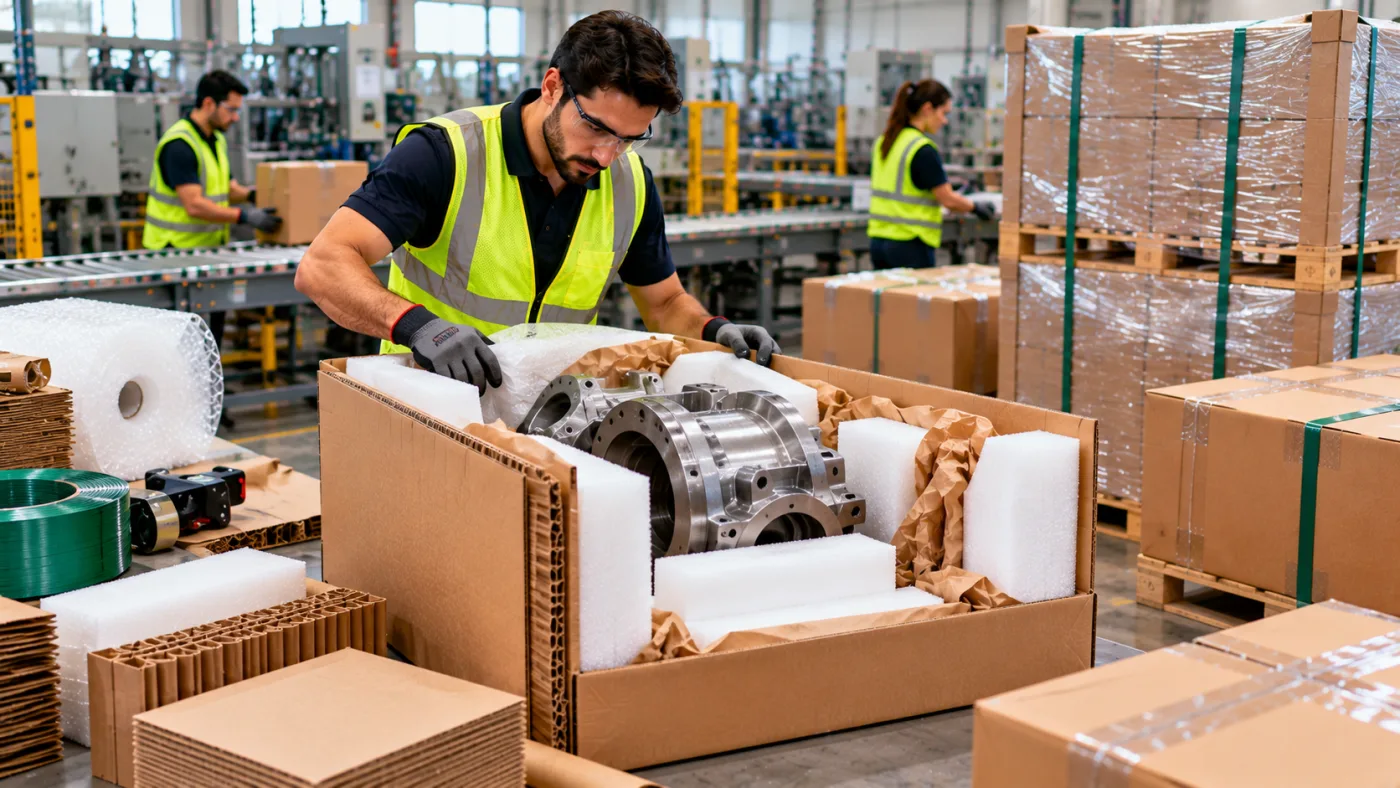
Manufacturers and distributors often handle packaging requirements that extend beyond preparing individual consumer parcels. Products may need to move between production facilities, warehouses, distributors, retailers, commercial customers, and transportation networks before reaching their final destination.
An effective industrial packaging system should therefore consider product weight, dimensions, fragility, storage, handling equipment, shipment volume, and whether products will move individually or as part of a palletized load.
What Are Industrial Packaging Supplies?
Industrial packaging supplies are materials used to contain, protect, seal, bundle, and stabilize products for commercial storage and transportation.
Depending on the operation, these can include:
- Corrugated cartons
- Protective packaging
- Packing paper
- Cushioning
- Carton sealing tape
- Stretch film
- Strapping
- Edge protection
- Load-containment materials
The correct combination depends on the product and shipping process.
1. Corrugated Boxes for Industrial Shipping
Corrugated cartons are commonly used for individual products, components, multi-item orders, and cases that will later be palletized.
Businesses should select cartons based on factors such as:
- Product dimensions
- Packed weight
- Required protection
- Stacking conditions
- Storage environment
- Transportation method
Explore Cardo's Corrugate solutions for commercial and industrial shipments.
2. Right-Size Industrial Cartons
Using a carton significantly larger than the product can create unnecessary empty space.
That may increase the need for:
- Void fill
- Cushioning
- Packing time
- Storage space
At the same time, a carton that is too small may leave insufficient room for required protection.
Businesses should account for both the product and its protective materials when choosing dimensions.
3. Protective Packaging for Industrial Products
Industrial products can be vulnerable to more than breakage.
Packaging may need to protect against:
- Impact
- Vibration
- Scratching
- Movement
- Product-to-product contact
- Edge damage
- Surface damage
Explore Cardo's Protective Packaging solutions.
The protective system should address the specific risks associated with the product.
4. Protect Heavy Components Appropriately
Heavy products can place greater demands on both the carton and protective materials.
Businesses packaging components or industrial parts should evaluate:
- Total packed weight
- Product shape
- Concentrated weight points
- Vulnerable edges
- Movement inside the package
Simply adding more loose void fill may not be the correct solution for a heavy product.
5. Separate Multiple Components
Several components packed together may require separation.
Direct product-to-product contact can lead to scratching, impact, or other damage.
Depending on the shipment, businesses may use:
- Corrugated dividers
- Individual wrapping
- Cushioning
- Surface protection
- Internal partitions
The packaging configuration should keep products appropriately positioned during handling.
6. Protect Finished Surfaces
Manufactured products may have painted, polished, coated, or otherwise sensitive surfaces.
Even when an item is structurally durable, cosmetic damage can create an unacceptable shipment.
Surface protection should therefore be considered separately from impact protection.
7. Use Suitable Carton Sealing Tape
Industrial cartons should remain securely closed throughout storage and transportation.
Tape selection can depend on:
- Carton construction
- Packed weight
- Surface condition
- Storage environment
- Shipping route
- Application volume
Explore Cardo's Tapes & Adhesives.
For repeat products, businesses can standardize the sealing method.
8. Standardize Packaging for Production Output
Manufacturers repeatedly producing the same products can benefit from predefined packaging specifications.
Instead of allowing employees to choose materials independently for every shipment, the business can document:
- Carton size
- Product orientation
- Protective material
- Divider requirements
- Tape application
- Units per carton
- Pallet configuration
This can support a more repeatable production-to-shipping workflow.
9. Prepare Cartons Correctly Before Palletization
Cartons should be fully packed and sealed before they are arranged onto a pallet.
Pallet containment should not replace the packaging required for the individual products.
Before palletizing, inspect cartons for:
- Damage
- Poor closure
- Bulging
- Incorrect product fit
- Excessive empty space
Problems are easier to correct before the complete load is assembled.
10. Build Stable Pallet Loads
Industrial shipments frequently involve multiple cartons consolidated onto pallets.
A stable load begins with proper arrangement.
Consider:
- Weight distribution
- Carton dimensions
- Layer patterns
- Load height
- Pallet condition
- Overhang
Heavy cartons should not be positioned in ways that unnecessarily compromise lighter packages.
11. Use Stretch Film for Load Containment
After cartons are arranged into a stable configuration, stretch film can help contain the load.
Explore Cardo's Stretch Wrap Film solutions for commercial pallet wrapping.
Film application should be matched to the load rather than using excessive material to compensate for poor stacking.
12. Consider Strapping for Challenging Loads
Certain industrial loads may require additional containment.
Strapping may be appropriate for selected:
- Heavy loads
- Bundled products
- Tall pallets
- Irregular shipments
- Commercial components
Explore Cardo's Strapping & Load Containment.
Edge protection may also be appropriate depending on the shipment.
13. Packaging for Irregular Products
Not every industrial product fits neatly into a standard carton.
Irregular items may require additional planning around:
- Product orientation
- Exposed edges
- Empty space
- Load balance
- Surface protection
Businesses should identify vulnerable areas rather than simply adding large amounts of general-purpose packaging.
14. Consider Warehouse Storage Conditions
Industrial packaging may spend time in storage before transportation.
Businesses should consider the expected environment when choosing materials.
Relevant factors may include:
- Storage duration
- Temperature
- Moisture exposure
- Stacking
- Warehouse handling
- Product sensitivity
Packaging requirements should reflect the complete journey, not only the moment the product leaves production.
15. Organize Industrial Packaging Inventory
High-volume facilities can consume packaging materials quickly.
Frequently used supplies should be monitored separately from specialized materials.
Businesses can track:
- Corrugated cartons
- Tape
- Protective packaging
- Stretch film
- Strapping
This can help purchasing teams identify when replenishment is required.
16. Establish Reorder Points
Critical packaging shortages can interrupt shipping operations.
Reorder points can be based on:
- Average consumption
- Supplier lead time
- Available inventory
- Storage capacity
- Expected production volume
Materials required for daily shipping may need closer monitoring than specialty supplies.
17. Consider Packaging Efficiency at the Production Line
Packaging can become a bottleneck if the process is unnecessarily complicated.
Review whether employees spend excessive time:
- Finding materials
- Selecting cartons
- Cutting protective packaging
- Filling oversized boxes
- Applying unnecessary tape
- Rebuilding unstable pallets
Standardized supplies and procedures can make repeat tasks easier to manage.
18. Inspect Industrial Shipments Before Dispatch
Before a shipment leaves the facility, inspect the completed package or pallet.
Check:
- Product stability
- Carton condition
- Protective packaging
- Tape application
- Pallet stability
- Stretch-film condition
- Strapping where applicable
- Required shipping identification
Visible issues can then be corrected before transportation.
19. Track Packaging Failures
If certain products are repeatedly damaged, businesses should record the packaging configuration involved.
Look for patterns involving:
- Product movement
- Carton size
- Surface damage
- Edge damage
- Cushioning
- Pallet configuration
The solution should address the cause rather than automatically increasing every packaging material.
20. Review Packaging When Production Changes
Industrial packaging specifications should not remain fixed when the product or production process changes.
Review packaging when:
- Product dimensions change
- Product weight changes
- New components are added
- Shipment quantities increase
- New markets are served
- Transportation methods change
Packaging should remain aligned with current operations.
Build a Complete Industrial Packaging System
The best industrial packaging supplies are those selected as part of a complete system.
Corrugated cartons can provide external structure, protective materials can address product-specific risks, tape can secure individual boxes, and stretch film or strapping can help contain palletized loads.
Manufacturers and distributors can improve consistency by standardizing repeat shipments, monitoring packaging inventory, and reviewing packaging whenever products or shipping requirements change.
Cardo provides corrugated packaging, protective materials, tapes and adhesives, stretch film, strapping, and other commercial packaging supplies for manufacturers, warehouses, distributors, fulfillment operations, and other businesses serving Canadian and U.S. markets.