

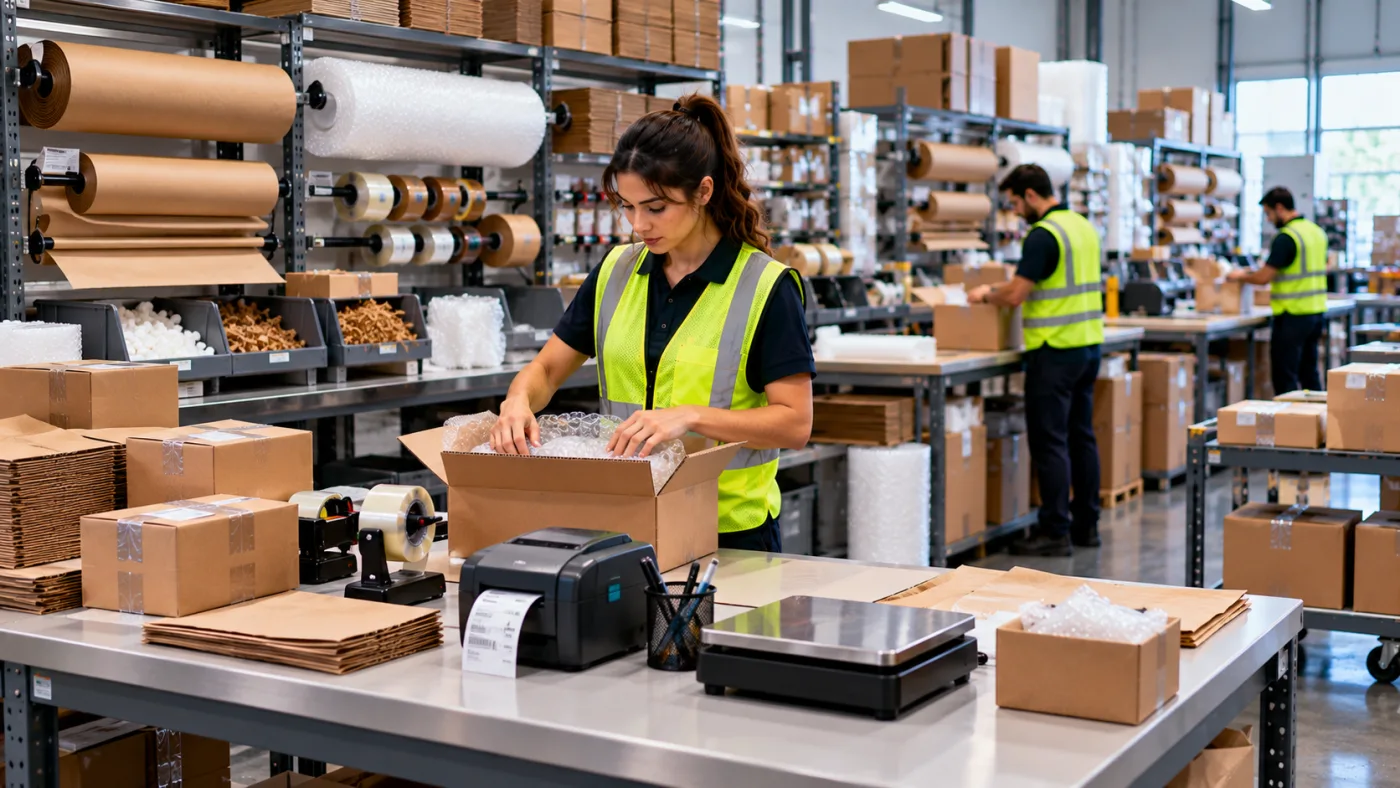
A packing station is where products, packaging materials, tools, and shipping information come together before an order leaves the warehouse. When this area is poorly organized, employees may spend unnecessary time searching for boxes, walking for supplies, replacing missing tools, or deciding how each product should be packed.
A well-planned warehouse packing station should support the products being shipped, the packaging process, and the daily order volume without becoming overcrowded with materials that are rarely used.
Start With Your Packing Workflow
Before rearranging shelves or purchasing additional equipment, review how an order currently moves through the packing area.
A typical process may include:
- Product arrives at the station.
- Employee verifies the order.
- Packaging is selected.
- Protective material is added.
- Carton is sealed.
- Shipping label is prepared.
- Finished parcel moves to dispatch.
The workstation should support this sequence with as little unnecessary movement as practical.
Keep Common Shipping Boxes Close
Corrugated cartons used every day should be easier to access than specialty boxes used occasionally.
Review shipment history and identify the sizes responsible for most orders.
Those cartons can receive priority positions near the packing area.
Explore Cardo's Corrugate solutions for commercial and e-commerce shipping.
Don't Store Every Box Size at the Workstation
A packing station has limited space.
Trying to keep every carton size beside the employee can create clutter and make common materials harder to access.
A better arrangement may be:
Packing station → High-use carton sizes
Reserve storage → Less frequently used cartons
Specialty packaging can then be retrieved when required.
Position Protective Packaging by Usage
Protective materials should also be organized according to how frequently they are needed.
This may include:
- Packing paper
- Bubble cushioning
- Void fill
- Dividers
- Corner protection
- Surface protection
Explore Cardo's Protective Packaging.
High-use materials should be accessible without unnecessarily interfering with the work surface.
Give Each Packaging Material a Defined Location
Employees should not need to search for common supplies during every order.
Assign designated locations for:
- Boxes
- Mailers
- Tape
- Protective packaging
- Labels
- Measuring tools
- Cutters
- Scales
A defined location also makes it easier to notice when a supply is running low.
Keep Carton Sealing Tape Accessible
Tape is used repeatedly at many packing stations.
The tape and dispenser should be positioned where employees can reach them easily while closing cartons.
Explore Cardo's Tapes & Adhesives.
Reserve tape inventory can remain away from the workstation while a practical working quantity stays nearby.
Use a Suitable Work Surface
The work surface should provide enough space to prepare the types of orders commonly handled at the station.
If employees regularly pack medium or large cartons, a worktop designed only for small parcels can create unnecessary difficulty.
The station should allow employees to:
- Assemble cartons
- Position products
- Add protection
- Close boxes
- Apply labels
without constantly moving unrelated materials.
Position the Shipping Scale Strategically
If parcels are weighed during fulfillment, the scale should fit naturally into the workflow.
Employees should not need to carry every finished carton across the warehouse simply to obtain its weight.
The appropriate position depends on the workstation and shipment sizes.
Keep Measuring Tools Available
Product and package dimensions may need to be checked during packing.
Basic measuring tools can be kept at the station for situations where employees need to verify:
- Product dimensions
- Box dimensions
- Completed parcel size
Frequently shipped products can also have preferred packaging specifications documented in advance.
Organize Shipping Labels and Documentation
Shipping labels should be generated and applied in a controlled area of the workflow.
Finished labels should not become mixed between multiple orders.
Where documentation is required, employees should have a clear process for keeping the correct paperwork with the correct shipment.
Separate Incoming and Completed Orders
Mixing unpacked products with finished parcels can make the station harder to manage.
Where practical, create separate areas for:
- Orders waiting to be packed
- Orders currently being packed
- Completed shipments
This creates a clearer flow through the workstation.
Reduce Unnecessary Walking
Observe employees during a typical packing shift.
If they repeatedly walk away from the station for the same material, consider whether that supply should be positioned closer.
Common examples can include:
- Tape
- Packing paper
- Common box sizes
- Labels
- Mailers
Reducing unnecessary movement can make the workflow more practical as order volume increases.
Avoid Overloading the Packing Station
Keeping materials close does not mean placing everything on the work surface.
Excessive supplies can reduce usable space and make the station difficult to maintain.
Use shelves, bins, racks, or nearby storage for materials that do not need to remain directly on the worktop.
Create Standard Packaging Instructions
The workstation becomes more efficient when employees already know how common products should be packed.
A simple specification can define:
Product → Packaging → Protection → Tape → Label
For more complex shipments, instructions can include:
- Product orientation
- Divider placement
- Void-fill requirements
- Carton size
- Special handling
This reduces repeated decision-making.
Use Visual Organization Without Cluttering the Area
Packaging materials can be grouped according to their function.
For example:
Cartons: one area
Protective packaging: one area
Tape and sealing tools: one area
Labels and shipping tools: one area
The goal is a logical arrangement employees can understand quickly.
Maintain Working Inventory at the Station
Packing stations do not need to hold the warehouse's entire packaging inventory.
Maintain enough working stock to support operations, then replenish from reserve inventory.
This can be especially useful for:
- Tape
- Mailers
- Protective materials
- Labels
A simple replenishment routine can prevent both shortages and clutter.
Create Reorder Signals
When employees notice that supplies are running low, there should be a clear way to trigger replenishment.
Businesses can establish minimum levels for high-use materials.
For example, when working inventory reaches a defined level, reserve stock can be brought forward or purchasing can be notified.
Prepare for Peak Order Volume
A workstation that works well during normal shipping periods may become congested during seasonal peaks.
Before expected increases in volume, review:
- Packaging inventory
- Workstation capacity
- High-use carton availability
- Tape
- Protective materials
- Labels
- Staffing requirements
Preparing the station before the peak can help reduce last-minute disruptions.
Consider Multiple Specialized Stations
As fulfillment operations grow, every station may not need to handle every type of shipment.
Businesses may eventually use separate areas for:
- Small parcels
- Standard e-commerce orders
- Fragile products
- Large cartons
- B2B shipments
Specialization can be considered when product variety and order volume justify it.
Keep Pallet Packaging Separate Where Practical
Pallet wrapping and strapping can require more space than individual parcel packing.
Larger commercial operations may benefit from keeping pallet preparation in a dedicated area.
Explore Cardo's Stretch Wrap Film and Strapping & Load Containment solutions.
This can prevent pallet activities from interfering with smaller parcel fulfillment.
Monitor Packaging Waste Around the Station
Packing areas can reveal inefficiencies quickly.
Look for excessive quantities of:
- Unused box cutoffs
- Discarded tape
- Unnecessary void fill
- Damaged packaging
- Abandoned cartons
Repeated waste can indicate that materials or procedures need to be reviewed.
Keep the Packing Area Clean
A clean station is easier to organize and inspect.
Remove unnecessary materials and damaged packaging regularly.
Tools should be returned to their designated locations after use so the next employee or shift can find them easily.
Review Packing Time
Businesses can monitor how long common orders take to prepare.
If a particular shipment requires significantly more time than expected, investigate why.
The cause may involve:
- Difficult box selection
- Poor product fit
- Excessive protective material
- Missing supplies
- Complicated instructions
- Poor workstation layout
The packaging configuration or station setup can then be improved.
Adjust the Station as Order Volume Grows
Packing station design should not remain fixed forever.
Review the setup when:
- Order volume increases
- New products launch
- More employees use the station
- New packaging formats are introduced
- B2B orders increase
- Fulfillment processes change
What works for a small operation may become inefficient at higher volume.
Build a Packing Station Around the Work
An efficient warehouse packing station should place frequently used packaging supplies and tools where they support the natural order-fulfillment workflow.
Right-sized corrugated boxes, protective materials, carton sealing tape, labels, scales, measuring tools, and organized reserve inventory can work together to create a cleaner and more repeatable packing process.
Cardo provides corrugated boxes, protective packaging, tapes, stretch film, strapping, and related shipping supplies for warehouses, e-commerce businesses, manufacturers, distributors, and fulfillment operations.