

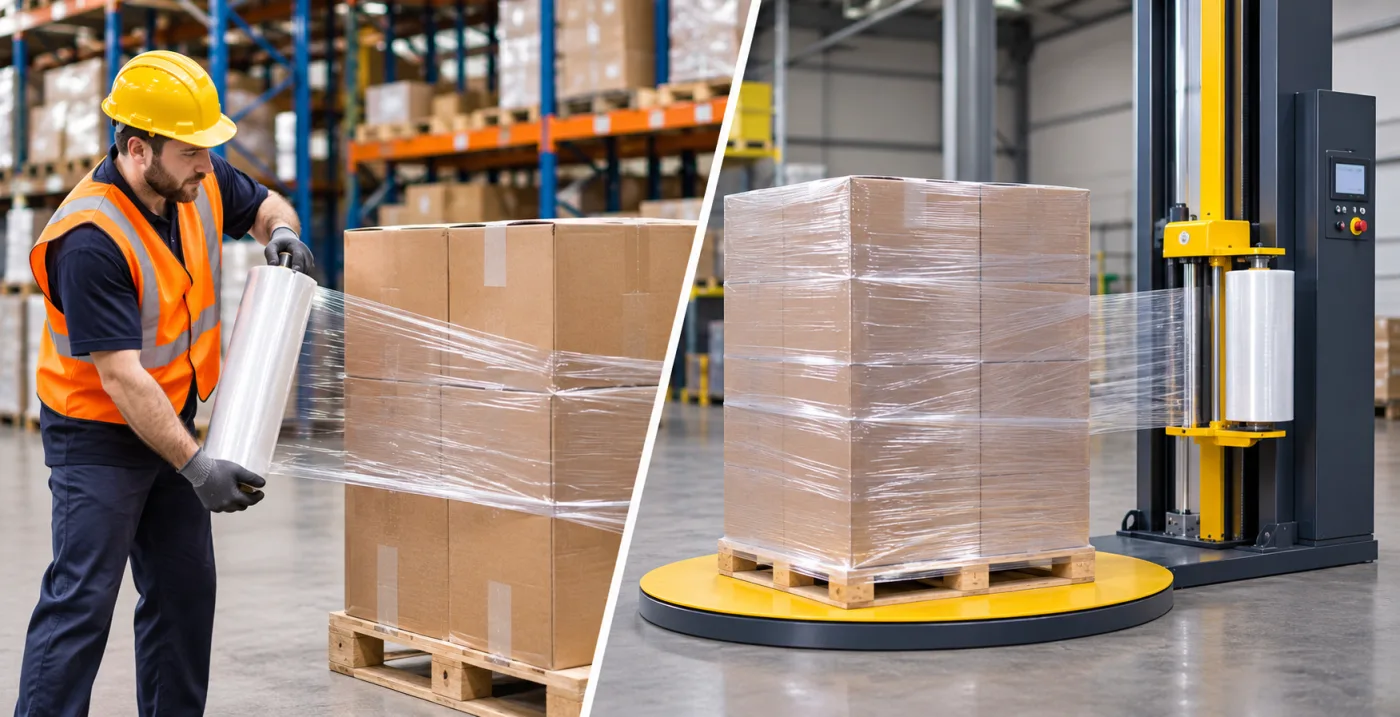
Choosing the right stretch film is an important part of keeping palletized shipments stable during warehouse storage, handling and transportation. Businesses that regularly prepare pallets need wrapping materials suited to their load weight, packaging volume and operational requirements.
Two commonly used options are hand stretch film and machine stretch film. Both help secure palletized products, but they differ in application methods, equipment requirements and efficiency.
Businesses can explore Cardo LLC's Stretch Wrap Film category when selecting materials for pallet wrapping and warehouse operations.
In this guide, we compare hand stretch film and machine stretch film to help businesses across the USA and Canada choose the most suitable option.
1. What Is Hand Stretch Film?
Hand stretch film is applied manually using a handheld roll or film dispenser. Warehouse employees walk around a pallet while applying film to secure cartons or products.
It is commonly used in smaller warehouses, retail distribution operations and businesses with lower pallet-wrapping volumes.
Benefits of Hand Stretch Film
- Requires minimal equipment investment.
- Suitable for occasional pallet wrapping.
- Flexible for different pallet sizes and configurations.
- Practical for smaller warehouse operations.
- Can be used where wrapping machines are unavailable.
Hand stretch film is often a suitable option for businesses that wrap a limited number of pallets each day.
2. What Is Machine Stretch Film?
Machine stretch film is designed for use with automated or semi-automated pallet wrapping equipment.
Depending on the machine and film specifications, this method can provide more consistent film application and controlled stretching.
Benefits of Machine Stretch Film
- Suitable for higher pallet-wrapping volumes.
- Helps improve wrapping consistency.
- Can reduce manual labor requirements.
- Supports repeatable wrapping procedures.
- May improve film efficiency when correctly configured.
Machine stretch film is commonly used in manufacturing facilities, distribution centers and high-volume warehouses.
3. Hand Stretch Film vs. Machine Stretch Film: Key Differences
| Feature | Hand Stretch Film | Machine Stretch Film |
|---|---|---|
| Application | Manual wrapping | Machine-assisted wrapping |
| Equipment | Hand dispenser | Pallet wrapping machine |
| Initial investment | Generally lower | Generally higher |
| Wrapping speed | Depends on operator | Often faster at high volumes |
| Consistency | Operator-dependent | More repeatable |
| Best suited for | Lower-volume operations | Higher-volume operations |
| Labor requirements | More manual involvement | Less manual wrapping |
The best option depends on pallet volume, load characteristics and equipment capabilities.
4. Which Stretch Film Is Better for Small Warehouses?
For businesses wrapping only a few pallets each day, hand stretch film may provide a practical and economical solution.
It requires limited equipment and allows warehouse employees to wrap different pallet configurations.
However, businesses should ensure that workers follow consistent wrapping procedures to maintain load stability.
For smaller operations, selecting suitable warehouse packaging supplies can also help simplify daily shipping activities.
5. When Should Businesses Consider Machine Stretch Film?
Machine stretch film may be more suitable when pallet-wrapping volume increases and manual wrapping becomes time-consuming.
Businesses should consider machine wrapping when:
- Large numbers of pallets are prepared regularly.
- Consistent film application is important.
- Manual wrapping requires significant labor time.
- Pallet configurations are reasonably standardized.
- Equipment investment can be justified by operational requirements.
Before investing in equipment, businesses should evaluate expected pallet volume and overall wrapping costs.
6. Consider Pallet Weight and Load Stability
The weight, shape and arrangement of products can affect the stretch film required for secure pallet wrapping.
Heavy or irregularly shaped loads may need different film specifications and wrapping patterns.
Businesses should evaluate:
- Pallet weight.
- Load dimensions.
- Product arrangement.
- Film puncture resistance.
- Required containment force.
- Transportation and handling conditions.
For certain applications, additional strapping and edge protection materials may help support load containment.
7. Compare Stretch Film Costs
The cost of stretch film involves more than the price per roll.
Businesses should consider the total cost of wrapping each pallet, including:
- Film consumption.
- Labor time.
- Equipment expenses.
- Maintenance requirements.
- Packaging waste.
- Load stability and damage risk.
Machine wrapping may reduce labor requirements and improve film consistency in higher-volume operations, but it also introduces equipment and maintenance costs.
Hand wrapping may remain more economical for businesses with occasional pallet shipments.
8. Improve Pallet Wrapping Efficiency
Regardless of the stretch film type, consistent wrapping procedures are important.
Warehouse teams should:
- Select film suitable for the load.
- Maintain appropriate film tension.
- Apply sufficient film at critical load areas.
- Avoid unnecessary overwrapping.
- Inspect wrapped pallets before shipment.
- Review material consumption regularly.
Pallet wrapping should also be considered alongside suitable corrugated packaging, particularly when multiple shipping cartons are stacked together.
9. Avoid Common Pallet Wrapping Mistakes
Some common mistakes can reduce packaging efficiency or compromise load stability.
Using the Wrong Film
Selecting film without considering load weight and wrapping equipment may result in poor performance.
Applying Too Little Film
Insufficient wrapping may allow cartons to shift during handling.
Excessive Film Usage
Using more film than necessary increases packaging expenses and waste.
Ignoring Load Configuration
Unevenly stacked cartons and unstable pallet arrangements cannot always be corrected by additional stretch film.
A stable pallet begins with proper product arrangement and suitable packaging materials.
10. How to Choose the Right Stretch Film
Before selecting hand or machine stretch film, consider these questions:
- How many pallets does your business wrap daily?
- What is the average pallet weight?
- Are your pallet loads consistent or irregular?
- Is wrapping equipment already available?
- What are your labor and material costs?
- What level of load containment is required?
Answering these questions can help identify the most appropriate wrapping method.
Frequently Asked Questions
What is the main difference between hand and machine stretch film?
Hand stretch film is applied manually, while machine stretch film is applied using pallet wrapping equipment. They differ in application methods, efficiency and equipment requirements.
Is machine stretch film more cost-effective?
Machine stretch film can be cost-effective for higher-volume operations, particularly when equipment improves wrapping consistency and reduces labor requirements. Total costs depend on the specific operation.
Can hand stretch film be used for heavy pallets?
Hand stretch film may be suitable for some heavier loads when the film specifications and wrapping method provide adequate containment. Load stability should be evaluated for the actual application.
Does machine stretch film reduce packaging waste?
Properly configured pallet wrapping equipment may improve film usage efficiency, but results depend on machine settings, film characteristics and load requirements.
Which stretch film is best for warehouse shipping?
The best stretch film depends on pallet weight, wrapping volume, equipment availability and transportation conditions.
Conclusion
Both hand stretch film and machine stretch film offer important benefits for commercial packaging operations.
Hand stretch film is often suitable for businesses with lower pallet-wrapping volumes, while machine stretch film can support greater consistency and efficiency in higher-volume warehouses.
For businesses across the USA and Canada, selecting the right stretch film involves evaluating load stability, packaging costs, labor requirements and operational needs.
Explore Cardo LLC packaging and shipping supplies to find materials suited to your warehouse and distribution operations.